Three Threes
"I think all this is somewhere in myself"

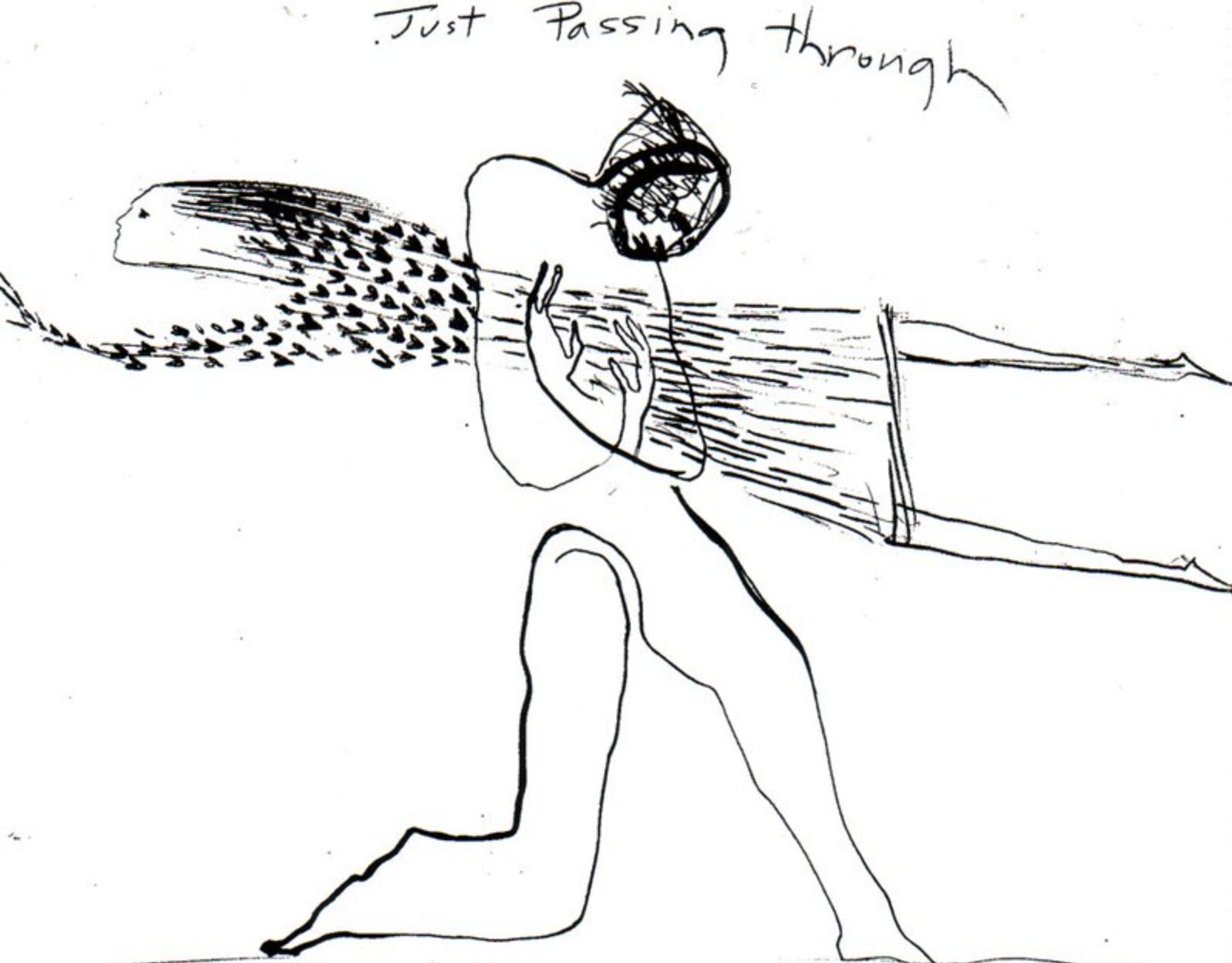
Artwork from the film Across The Universe.
I recently reread W.S. Merwin’s collection, The Lice, and was struck on this read by his smaller poems, especially those that employ various three-part structures (some overt, some subtle). These poems have a haiku-ish quality, even when their “threeness” is obscured by their larger formal structures. What I love about a traditional haiku is the way it unfolds across three gestures, its observational powers often gaining complexity—building towards something, breaking something down, or pivoting all together, to highlight contrast—as it does. In The Lice, this quality is perhaps most evident in the poem, “Wish,” whose three couplets present three obliquely tied, but still tied thoughts:
Wish

The star in my
Hand is falling

All the uniforms know what’s no use

May I bow to Necessity not
To her hirelings
*
Each of these stanzas suggest a failing quality, a faltering, or a givingupness, but it does not totally succumb to despair, and certainly not to stillness or stiltedness. Across its three gestures, it moves from the lyric first person in the first stanza; (“my / Hand…”); then to the close(ish) omniscient point of view in the second, when the speaker looks outward at “the uniforms;” and back to the first person in the third stanza (“May I bow…”), though that person has been changed in the process of thinking. If the star has fallen out of his hand, and those in charge (perhaps) indicate that there is no hope, what can one do but return to simplicity, back to the basics, what is essential and nothing more? “Necessity,” that which one much ally themselves, rescues the now-starless, verging hopeless speaker. In a sense, the poem operates formally in the shape of problem-problem-solution, or meditation-observation-dedication, which vaguely resembles some of my favorite haiku, such as “A World of Dew” by Kobayashi Issa:
A world of dew,
And within every dewdrop
A world of struggle.
And “The Taste of Rain” by Jack Kerouac:
The taste
Of rain
—Why kneel?
As I was reading the Merwin and considering the brilliance of “The Wish,” that poem became a lens through which I began reading other poems in the book. This kind of haphazard, intuitive, or coincidental kind of scholarship is some of the most generative for me (don’t tell me my dissertation committee). Suddenly, I started seeing groups of three everywhere, even in Merwin’s monostitches, such as “Early January:”
Early January

A year has come to us as though out of hiding
It has arrived from an unknown distance
From behind the visions of the old
Everyone waited for it by the wrong roads
And it is hard for us now to be sure it is here
A stranger to nothing
In our hiding places
On first glance, this poem doesn’t operate in a set of three, but consider the following reanimation, with new stanza breaks I implemented (as the poet rolls in his grave):
     Early January

     A year has come to us as though out of hiding
     It has arrived from an unknown distance

     From behind the visions of the old
     Everyone waited for it by the wrong roads
     And it is hard for us now to be sure it is here

     A stranger to nothing
     In our hiding places
Merwin’s lack of punctuation gives the monostitch a fluid quality, which creates tension when experienced alongside his stable, relatively complete sentences. But if you dissect the poem into three parts, like I have done above, it is easier to see the motion of mind from one subject to another. In the first reconstructed couplet, the subject of the poem is “A year;” it has “arrived,” has “come to us,” “out of hiding” and” “from an unknown distance.” In the second stanza, Merwin more vividly portrays the scene and raises the stakes: he writes that “everyone waited: for the “year” to “come” “from behind visions of the old…” “by the wrong roads.” It is a more meditative stanza, ripe with uncertainty that resonates with “unknown distance.” It feels like a step further into, or out of, clarity. The third stanza, then, is more summative, more resolved, more like a volta against the previous two stanzas.
I did the same blasphemous work on the poem, “The Room,” which I think crystalizes Merwin’s sense of three-ness as I see it across his shorter works:
The Room

I think all this is somewhere in myself
The cold room unlit before dawn
Containing a stillness such as attends death
And from a corner the sounds of a small bird trying
From time to time to fly a few beats in the dark
You would say it was dying it is immortal
My reanimated version:
     The Room

     I think all this is somewhere in myself

     The cold room unlit before dawn
     Containing a stillness such as attends death
     And from a corner the sounds of a small bird trying
     From time to time to fly a few beats in the dark

     You would say it was dying it is immortal
I love how this poem takes its reader on a journey from the first person to the second person, as if handing off the responsibility for the utterance to the reader. The first line, “I think all this is somewhere in myself,” the “this” gesturing back to the idea of a “room,” has the mood of a spontaneous meditation. Then, the poem literalizes the idea, the “room” is “cold,” it contains “a stillness,” and inside of it, “the sounds of a small bird,” “a few beats in the dark.” These images imagine the experience of standing in a real space, while simultaneously constructing a metaphor of the internal world; remember, “all this is somewhere in myself.” And then, in a stunning final gesture, the “room” in the poem falls apart, like a box collapsing, and the poet is looking directly at us, his reader. The second person “you” implicates us, puts us in space next to him. His final thought, the most cryptic in the poem (and one of the most mysterious moments in The Lice, in my opinion), mashes together two contradictions: “it was dying it is immortal.” This is indeed a reference to the “bird,” but the bird, of course, is a metaphor, perhaps a metaphor for thought—“from time to time to fly a few beats in the dark—or the inner world at large.
I found it tremendously useful to “break down” these Merwin poems this way, especially because (and in spite of) the characteristic lack of punctuation in The Lice that often gives the poems a feeling of running together. I like this tension, how, formally, these poems have a a quality of wholeness, but when read carefully, and, perhaps “incorrectly,” you can see their seams.